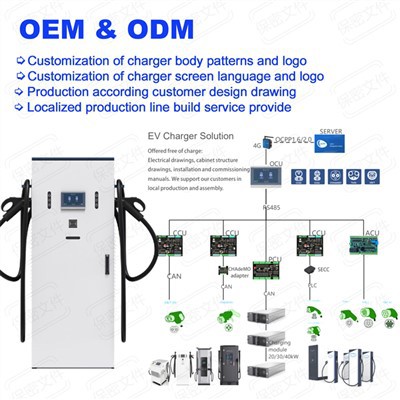
Basic Introduce
|
Items |
Product |
80KW CCS2 CCS1 Electric Car Charging Points |
|
AC input Data |
Input |
400V AC +/-15%, Rated 380VAC; 3 phase+ neutral + PE; 45-65Hz |
|
DC Output Data
|
Output |
80KW-120KW / 200-1000V DC / 200A |
|
Output Plugs |
CS2 / CCS1 /CHADEMO / GBT; cable length 5M or customized |
|
|
Communication |
Internet |
Ethernet/WIFI/4G communication |
|
Protocol |
OCPP1.6 |
|
|
Environmental Data |
Operating |
-30℃to +50℃;5% ~ 95% no condensation;≤2000m |
|
IP Level |
IP54 (Indoor/Outdoor) |
DC fast electric car charging points offer much quicker charging times compared to Level 2 AC stations, while being just as user-friendly. Just like using a standard charging point, you simply tap your phone or card, plug in your vehicle, and start charging. DC fast chargers are especially useful when you need a rapid charge, and you're willing to pay a bit more for the convenience-such as during a road trip or when your battery is low and you're pressed for time.


How Fast Can I Charge with a DC Charging Station?
Using a DC electric car charging points, you can charge your electric vehicle to almost full capacity in as little as 20 to 60 minutes. The exact time depends on the car's charging capabilities and the maximum output of the DC charger.
There are two main types of DC charging:
1. Standard DC Charging:
Standard DC charging typically operates at speeds of up to 50 kW. For example, with a 52 kWh battery, a Renault ZOE can charge from 0% to full in approximately one hour at this rate.
2. High-Power Charging (HPC):
HPC delivers significantly faster charging, often between 150 kW and 350 kW. For instance, a Hyundai IONIQ 5 can go from 10% to 80% in just 18 minutes when using a 350 kW DC charger. While both forms use direct current, HPC stands out for its much higher charging speed.
How to Use a Rapid Charging Station?
Park Your Vehicle: Position your car near the charger, ensuring the charging port is close to the station.
2. Connect the Charger: Take the appropriate charging cable from the station and plug it into your car's charging port.
3. Payment: Some electric car charging points support contactless payments, some may require an account or an app, normally the methods are typically displayed on the charger.
Hot Tags: 80kw ccs2 ccs1 electric car charging points, 80kw ccs2 ccs1 electric car charging points suppliers, manufacturers, factory, EV Station, EV Charging Systems, Electric Car Charging Infrastructure, Charging Station