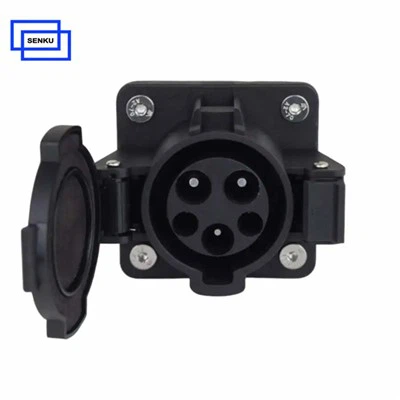
Brief Introduction
In 2011, SAE introduced a J1772/CCS Combo Coupler variation of the original J1772-2009 connector to accommodate the Combined Charging System (CCS) for DC fast charging. This new variant includes the standard 5-pin J1772 connector along with two additional larger pins for enhanced DC fast charging capabilities. Combo 1 supports charging from 200–920 volts DC and power levels up to 350 kW.
The combo coupler also incorporates power-line communication technology to facilitate communication between the vehicle, the external charger, and the smart grid. By late 2011, several leading automakers-including Audi, BMW, Daimler, Ford, General Motors, Hyundai, Porsche, Volvo, and Volkswagen-had agreed to adopt the Combined Charging System starting in mid-2012. The first models to use the SAE CCS1 Electric Car Charging Sockets were the BMW i3, which launched in late 2013, and the Chevrolet Spark EV, which debuted in 2014.


Application:
The 60A CCS1 Electric Car Charging Socket is a critical component in electric vehicle (EV) infrastructure, carefully designed to meet the needs of various battery electric vehicles (BEVs) and plug-in hybrid electric vehicles (PHEVs). This CCS1 Charging Sockets complies with the widely recognized J1772 standard in North America, ensuring compatibility and interoperability with various electric and hybrid vehicles.

Know difference between Electric Vehicles (BEV) and Plug-in hybrid electric vehicles (PHEV)
J1772 vs Tesla (NACS)
The J1772 connector, embraced by a majority of non-Tesla electric vehicle makers, is the outcome of collaborative efforts by industry leaders to establish a universal, straightforward EV charging system. It is distinguished by its compatibility, safety features, and widespread accessibility, playing a crucial role in simplifying the EV charging network and enhancing convenience for drivers.
In contrast, Tesla has developed its own distinctive pathway by launching the North American Charging Standard (NACS), a cornerstone of Tesla's exclusive charging ecosystem. This autonomous strategy has enabled Tesla to enhance the charging process significantly, offering a connector that supports both Level 2 and rapid DC charging.
Both the J1772 and NACS are significant in their contributions to the development of the electric vehicle industry, each shaped by unique design principles and technical capacities. The following sections will explore the contrasts between these standards, evaluating their strengths and weaknesses and their impact on the growing EV market.
J1772 vs. Tesla (NACS): Charging Infrastructure Comparison
The charging infrastructure is vital in driving the adoption and functionality of electric vehicles. Analyzing the widely accepted J1772 standard against Tesla's NACS reveals two distinct charging ecosystems, each addressing the different requirements of EV users.
The J1772 standard supports a broad charging network that includes North America and goes beyond Tesla, providing extensive coverage with Level 1 and Level 2 stations. This network services a variety of EVs and is bolstered by the CCS1 upgrade, which combines the J1772 connector with additional pins for DC fast charging, merging routine and rapid charging capabilities.
On the other hand, Tesla's NACS, initially exclusive to Tesla vehicles until 2022, has created a robust fast-charging network known as the Supercharger network. Positioned strategically along key highways and urban areas, it supports long-distance travel for Tesla owners. Although this network is comprehensive, Tesla has recognized the benefits of broader compatibility, introducing adapters that allow access to J1772 stations.
The J1772 system, especially with the CCS1 extension, offers extensive access and compatibility for numerous vehicle brands, contrasting with the exclusive, high-speed charging environment provided by Tesla's NACS and Supercharger network. As the EV landscape continues to evolve, these differences highlight a growing focus on harmonizing various charging infrastructures to meet the diverse needs of all EV drivers.
Hot Tags: 60a j1772 ccs1 electric car charging sockets, 60a j1772 ccs1 electric car charging sockets suppliers, manufacturers, factory, type 1 charging socket, electric vehicle charger plug, j 1772 electric plug in stations, standard ev charging port, j1772 ccs combo connectors, 16A 32A 40A 50A Type 1 Electric Car Charging Socket 250V AC J1772 Inlet