

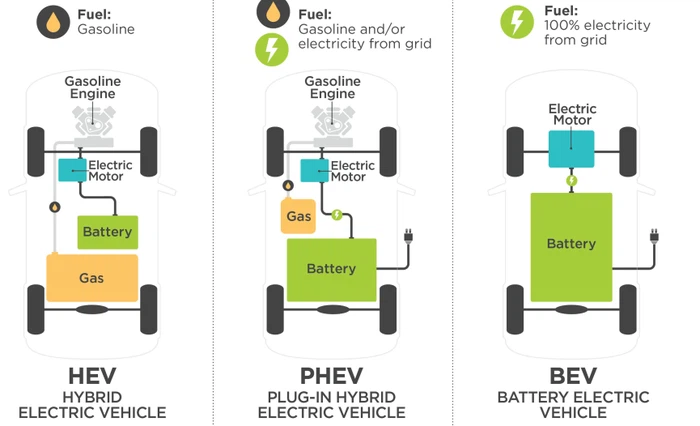
The power of a Battery Electric Vehicle (BEV) is entirely derived from the battery. Simply put, it relies solely on the power battery and drive motor to provide power for the vehicle to travel. It mainly consists of auxiliary systems such as chassis, body, power battery, drive motor, and electrical equipment.
Main advantages: zero emissions, almost no pollution (excluding pollution generated during the production of battery raw materials), low noise, low daily use and maintenance costs of vehicles.
Main drawbacks: Currently, the range still does not meet the standards expected by consumers (generally considered 1000 kilometers of range as a milestone); At present, the infrastructure is not yet complete and the charging time is long.
The main source of power for hybrid electric vehicle (HEV) models is still fuel, but adding an electric drive system to the traditional car drive system for hybrid drive reduces the demand for fuel. Generally, in the initial stage, cars are driven by electric motors. When the speed exceeds a certain threshold, the engine and electric motor work together to drive the car, which can effectively reduce the average fuel consumption of the vehicle. At the same time, when braking or going downhill, it is equipped with a braking energy feedback system that can charge the battery to achieve energy cycling.
Plug in hybrid electric vehicle (PHEV) - PHEV has both the engine, transmission, and transmission system of traditional cars, as well as the battery, electric motor, and control circuit of pure electric vehicles. Moreover, the battery capacity is relatively large and there is a charging interface; It combines the advantages of BEV and HEV, and is "oil and electric", which can achieve pure electric driving and increase the vehicle's driving range through hybrid mode. Main advantages: Energy saving, environmentally friendly, low pollution, and can be used as a standalone pure electric vehicle. Compared to pure electric vehicles, it does not cause range anxiety because it has an additional power system that can provide more ample power and a longer driving range.
Main disadvantages: The cost of two power systems, an electric motor and an internal combustion engine, is higher than that of one power system; 2. Long term high-speed or uniform driving is not fuel-efficient. Plug in hybrid vehicles now commonly use hybrid or parallel structures for their internal structure.
Range Extended Electric Vehicle (REEV) is a type of electric vehicle that adds an engine to the vehicle. It does not directly drive the wheels, but only generates electricity. When the battery runs out of power, the internal combustion engine will be started to charge the battery. Once the battery is charged, it will continue to drive the vehicle.
Main advantages: Low fuel consumption, as the engine is only responsible for charging, only a small displacement engine is needed to complete the task.
Main disadvantage: Extended range electric vehicles have high fuel consumption on highways. Due to the additional conversion process of range extender plug-in hybrid power on highways, it consumes energy and results in higher fuel consumption.
Tags: #BEV #PHEV #HEV #REEV