


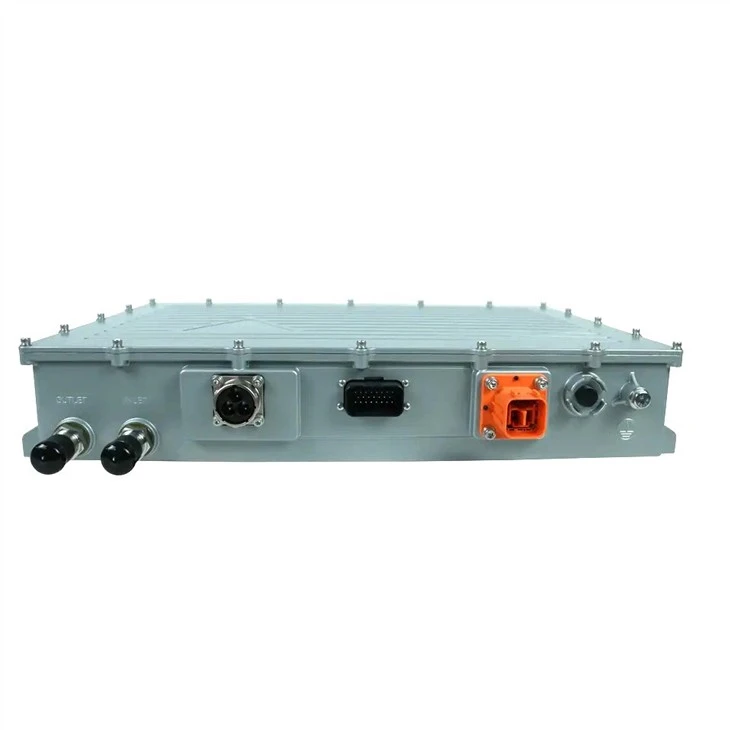


Brief Introduction
Fast Charging 3 Phase OBC 22KW 450V is the key to maintain the power supply of electric vehicles. They obtain AC power from the owner's home and convert it into DC power to charge the battery.

Highlights of the 22KW OBC
√ IP67 IP protection
√ Liquid cooling
√ CAN bus control
√ AC charging up to 22 kW
√ Compatible with EU & US power grid
√ Fully compliant with charging stations:
SAE J1772, IEC61851 and GB/T 20234

On-Board Charger
The process of charging an electric vehicle relies on three key components, and the overall charging speed is dictated by the component with the lowest capacity. These components include the charging station, the charging cable, and the on-board charger. Among these, the on-board charger is the least familiar. But how exactly does it function? What are the fundamental types of on-board chargers? And what can we expect in the future?
Understanding the Charger
The term "charger" can be a bit misleading. Often, the charging station is referred to as a charger, so it's important to differentiate between two distinct types:
On-board charger (OBC)
This is integrated into the vehicle.
Charging station
Also known as a charger, this can provide either AC or DC power and is technically termed Electric Vehicle Supply Equipment (EVSE).
How Charging Operates
Charging an electric vehicle can be done in two primary ways: using direct current (DC) or alternating current (AC). When AC power is employed-whether from a standard outlet or an AC charging station-the current travels through the charging cable to the on-board charger. The on-board charger then converts the AC into DC, which is directed to the battery through the Battery Management System (BMS).
Product Range for Reference

Application of the Products

Hot Tags: fast charging 3 phase obc 22kw 450v, fast charging 3 phase obc 22kw 450v suppliers, manufacturers, factory
Technical data of the 22kW OBC (AC to DC)
|
AC Input Characters |
||
|
Input voltage range |
V AC |
152– 480 |
|
Input frequency range |
Hz |
47 – 63 |
|
Max. input current (eff) |
A |
32 |
|
Max input power |
kVA |
22 |
|
DC Output Characters |
||
|
Output voltage range |
V DC |
100-450 |
|
Min. voltage Constant Power range |
V DC |
384 |
|
Other Characters |
||
|
Operation ambient temperature |
℃ |
-40~85 |
|
Storage ambient temperature |
℃ |
-40~95 |
|
Environment Humidity |
% |
5-95 |
|
IP protection |
% |
IP67 |
|
Cooling method |
/ |
Liquid cooling |
|
Communication |
/ |
CAN bus protocol (250/500 kbps) |
Dimensions of the 22kW OBC

|
OBC Protections |
Definition of the protection functions of the 22KW OBC 450V |
|
Over voltage protection |
can be self-recovery from input or output over-voltage shutdown |
|
Under voltage protection |
can be self-recovery from input or output under-voltage shutdown |
|
Short circuit protection |
Output short circuit shutdown, self-recovery |
|
Over temperature protection |
When the temperature of the radiator is higher than 75℃, the output power is reduced, when the temperature is higher than 95℃, the circuit is disconnected, and when the charging temperature is restored to below 85℃, the output of the charger is restored |
|
Reverse connect protection |
Output Reverse Switch-on does not start, alarm, normal work after recovery |
|
Equilibrium potential and ground protection |
The resistance between the conductive part directly touched by the human body and the potential equilibrium point in the vehicle charger is not more than 0.1Ω. The grounding point of vehicle charger should have obvious grounding mark. |
|
Power-off protection |
Cut off power supply in abnormal condition |
Connectors Definition of the 22kW OBC

|
No. |
Definition |
|
1 |
Input connection |
|
2 |
Signal connection |
|
3 |
Output connection |
|
4 |
PE |
|
Inlet |
Liquid cooling input |
|
Outlet |
Liquid cooling output |


