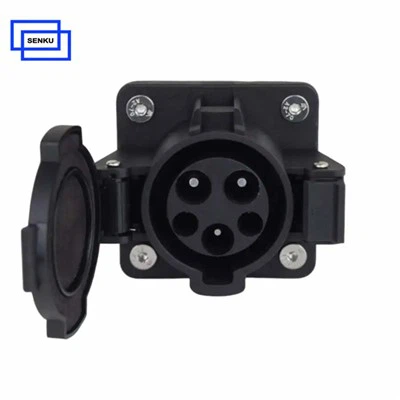
Baisc Information
This Mode 3 16A Electric Car Charging Cable is used at all public charging stations with a Type 2 outlet socket. One side of the connector plugs into the charging station's outlet socket, while the other side connects to the EV's inlet charging socket. The Type 2 to Type 2 charging cable supports charging from 16A to 32A, with power ranging from 3.5 kW to 22 kW.
Product Features
16A Electric Car Charging Cable:
• High-quality EV charging cable for use with home and public charging equipment.
• Highly compatible, the EV charging cable is CE and TUV certified and complies with all Type 2 (IEC 62196) electric vehicles.
• This EV charging cable is made of flexible and lightweight rubber, making it easy to store and transport.
• Strong and anti-aging cable: The strong molecular structure provides a long-lasting charging solution, ensuring a longer service life.
• IP55 weatherproof for both outdoor and indoor use.
Technical Specification
Charging Mode: Mode3 (type 2 to type 2 ev charging cable)
Current / Voltage: 16A 250V AC 3.5KW
Certifications: TUV CE, UKCA
IP Level: IP55
Cable Length: 5M Or Customized


Some Common Query
Plug terminals not latching
- Please make sure to use considerable pull force when plugging in the charging station and vehicle.
Charge settings on car
- Make sure there is no timers or other settings turned on of the vehicle.
Car is locked unable to charging
- Please note the vehicle needs to be unlocked and turned off the engine before to start the charging process.
Plugging into another cable
- This cable must insert directly into a Type 2 socket, Please do use it with other type sockets.
How to Choose the Length of a Electric Car Charging Cable ?
The length of the Electric Car Charging Cable should be determined based on multiple factors, including the location of the charging point, the parking position of the vehicle, safety, efficiency, and cost.
An unreasonable configuration and use of charging station cables can often lead to a series of problems. These issues mainly involve several aspects such as safety, efficiency, and economy:
1. Electrical Safety Issues: Longer charging cables increase the risk of short circuits and insulation failures, especially in outdoor environments where the cables may be affected by weather factors such as rain and high temperatures.
2. Mechanical Damage Issues: Long cables may be left scattered on the ground after use, making them susceptible to being run over by passing vehicles, which can damage the external insulation layer of the charging cable and increase the risk of electric leakage and shock.
3. Efficiency and Performance Issues: These are mainly related to power loss. According to Ohm's Law, when current flows through a conductor, heat is generated, which represents energy loss due to resistance. This means that the longer the cable, the greater the resistance and power loss, which can reduce charging efficiency to some extent.
4. Charging Speed Issues: Due to power loss, a longer cable may cause a decrease in the actual voltage reaching the battery, thereby affecting the charging speed and prolonging the charging time.
5. Waste of power resources: Due to power loss, some electrical energy is converted into heat energy and dissipated, which not only increases charging costs but also wastes power resources.
Hot Tags: 16a electric car charging cable, 16a electric car charging cable suppliers, manufacturers, factory, ev charger cable, type2 to type2 ev charging cable, 10m type 2 ev cable, ev charge cable type 2, type 2 to type 2 cable